

Same Muscle Growth at 20% Load: The NFL Recovery Trick Runners Keep Missing
Estimated read time: 4.0 minutes (about as long as it takes to explain to my grandma why I'm wearing tourniquet cuffs at the gym - She still doesn't get it 🤔)
Hey Performance Nerds! Jonah here. 🤓
Same muscle growth at 20% of the weight. That's BFR in one sentence.
Every NFL athlete I worked with used blood flow restriction training. Most runners have never tried it.
What you'll learn today:
Why 20% load triggers the same muscle growth as heavy lifting
The fiber recruitment trick that makes light weights feel heavy
How BFR builds strength without wrecking your running
(Augie thinks strapping bands around your legs sounds like a lot of work for a nap. He's not wrong.)
🎁 Quick note before we start, yes, we’re giving away super shoes (no gimmicks)
I'll be real with you. I'm trying to build the most science-first running community possible. It's become my passion (besides dogs and ice cream).
Part of that means growing this the right way. Bringing more runners in so we can do bigger things, like connecting you directly with the PhDs and researchers actually doing the work.
So we're running a referral giveaway. Over $1,000 in running gear. 12 hours left.
If Marathon Science has helped you train smarter, this is an easy way to support what we’re building, and not go home empty-handed.
👉 Do you want to participate in the Marathon Science referral contest?
🧬 Performance Sponsors:
🧪 Science in Sport, 15% Off for This Community
I don’t share many discount codes. This one matters.
I use Science in Sport because their products are built from published research, tested with elite athletes, and actually hold up in hard training blocks.
To celebrate their U.S. launch, you can get 15% off with code JONAH26
Same fuel I use. No guesswork. No influencer fluff.

🧬 What Is Blood Flow Restriction Training?
The concept is simple: partially restrict blood flow to a working muscle during exercise.
You wrap specialized cuffs around your upper arms or thighs. Then you train with light weights, typically 20-30% of your one-rep max.
The result? Muscle adaptations that rival heavy lifting, without the mechanical stress.
What it looks like in practice:
Cuffs inflated to 50-80% of your arterial occlusion pressure (the pressure that would fully stop blood flow)
Light resistance exercises (bodyweight, cycling, walking, machines or 20-30% 1RM)
Higher rep ranges (15-30 reps per set)
Short rest periods (30-60 seconds)
The magic isn't the bands. It's what happens inside the muscle.
🔬 The Physiology in 60 Seconds
Blood carrying oxygen flows IN. Blood carrying waste flows OUT.
BFR cuffs block blood from leaving while still letting some enter. Blood pools.
Waste products accumulate faster than normal. This creates rapid local fatigue in the muscle.

Here's what most miss:
Fatigue is the trigger, not the direct driver.
Your nervous system responds to that fatigue by recruiting your strongest muscle fibers. These are your fast-twitch muscle fibers, the ones you normally only recruit under heavy loads.
Why This Matters
Normally, you'd need to lift 70-85% of your max to recruit those fibers. Or lift moderate weights to failure.
With BFR, your body recruits them early at just 20% load.
Each fiber takes a turn as others fatigue. Every fiber that gets recruited experiences mechanical tension, even though the total load is light.
That mechanical tension on individual fibers drives muscle growth.
The mechanism chain:
Low load + BFR = rapid local fatigue
Fatigue forces recruitment of fast-twitch fibers
Each recruited fiber experiences mechanical tension
Mechanical tension triggers the muscle building signal
Your body can't tell the difference between "heavy weight" and "light weight with fatigue-forced fiber recruitment." The growth signal is the same.
That's the mechanism. Here's proof it works.
💪 The Strength and Hypertrophy Evidence
Hypertrophy (Muscle Growth)
A 2024 meta-analysis found BFR and heavy training produce similar muscle growth.
Training Type | Load | Hypertrophy Response |
|---|---|---|
Traditional Heavy | 70-85% 1RM | 5-6% gains |
BFR Training | 20-30% 1RM | 4-5% gains |
Low-Load (No BFR - when not taken close to failure) | 20-30% 1RM | Significantly less |

Nearly identical muscle growth at a fraction of the load.
Strength Gains
Strength gains with BFR are similar or slightly lower than heavy training.
This makes sense. Strength is partly neural (your brain), and heavy loads train that neural component more directly.
The trade-off for runners:
Heavy lifting = high mechanical stress = 24-72+ hours recovery
BFR training = low mechanical stress = potentially faster return to quality running
For endurance athletes managing training load, that trade-off often favors BFR.
The hypertrophy data is clear. But for runners, there's another question: what's the recovery cost?
⚡ The Fatigue Advantage (Why Runners Should Care)
Traditional heavy lifting comes with a cost:
Muscle damage requiring 48-72+ hours recovery
Signs of muscle damage
That day-after soreness
Interference with running quality if poorly timed
BFR changes the equation.
A 2017 study found heavy lifting caused more muscle damage 24 hours later. The BFR group? No significant change.

Similar muscle growth. Fraction of the damage.
BFR works when heavy lifting won't:
Injury rehab: Build muscle at loads your body can tolerate.
Deep in a training block: Skip the recovery hole from heavy deadlifts.
Nagging issues need attention: Get your calf work done without heavy loading. (You know how I feel about calf training.)
Protecting key runs: Swap heavy leg day for BFR. Same stimulus, fresh legs for intervals. (Your Strava crush will still see you flying.)
This is why every NFL team uses it. Maintain strength without compromising sport practice.
I don’t recommend replacing your regular strength training with BFR. I use it selectively, when heavy loading isn’t the right tool.

🎯 Part 1 Takeaways
BFR restricts blood from leaving the muscle. Blood pools and creates metabolic fatigue
Light loads match heavy lifting for muscle growth. No need to grind through heavy squats.
Light loads recruit fast-twitch fibers. Fatigue forces your nervous system to call them in.
Recovery cost is dramatically lower. Train again sooner.
Optimal cuff pressure is 50-80% of arterial occlusion pressure. Higher isn't better.
Bottom line: BFR gives you heavy-lifting muscle growth with light-lifting recovery.
Coming in Part 2:
Can BFR actually improve your running performance?
How do VO2max and capillary density respond to BFR?
The practical protocol for runners
Quick note on what I actually use.
When I use BFR, I use Hytro.
They’re one of the few companies I genuinely respect because they fund and support independent research on BFR, not just marketing claims.
They’re not sponsoring this newsletter, and they’re not paying me to say this.
This is just the tool I use personally and the one I trust.
If you’re curious, here’s the link → Learn More Here
If you have any questions about how to incorporate BFR, or how I personally use it in training, just hit reply.
I read every message and I’m happy to help you think through it.
Are You a True Running Nerd? Prove it.. 🧐
Welcome to the prove you’re a nerd section. Each week, I ask a question about a common running science myth.
Answer correctly, and you’ll be entered into a weekly raffle to win a package of Jonah’s favorite supplements.
Why doesn’t high-mileage running reliably improve bone density the way heavy strength training can?
- A. Running loads bone repeatedly but rarely with enough strain magnitude to trigger new bone formation 🦴⚡
- B. Bone adapts mainly to fatigue, not mechanical loading 😮💨🧠
- C. Running prioritizes aerobic adaptations over skeletal adaptations 🫁🏃♂️
- D. Bone density only responds to impact, not muscular force 💥🚫
Last Week’s Results: The Foam Is Doing the Heavy Lifting 🧪👟
Super shoes get talked about like magic, but this question showed most of you understand what’s actually driving the gains.
The correct answer?
A. The resilient midsole foam reducing mechanical energy loss 🧪👟 ✅
PEBA-based foams improve running economy because they lose less energy when compressed and rebound. Each step costs a little less, not because the shoe adds energy, but because it wastes less of the energy you already produce.
The carbon plate helps, but mainly by stabilizing the foam and guiding how it deforms. It’s not acting like a spring launching you forward. And while stack height and cushioning affect comfort and joint loading, they’re not the primary economy drivers.
Here’s how the votes shook out:
🟩 A. The resilient midsole foam reducing mechanical energy loss 🧪👟 – 146 ✅
🟨 B. The carbon plate acting as the main source of elastic energy return 🦴⚡ – 62
⬜️ C. Higher stack height passively reducing ankle and knee work 📏🦵 – 13
⬜️ D. Softer cushioning lowering peak impact forces ☁️⬇️ – 14
Bottom line?
Super shoes don’t make you faster by adding bounce. They make you faster by leaking less energy every step, which adds up fast over a marathon.
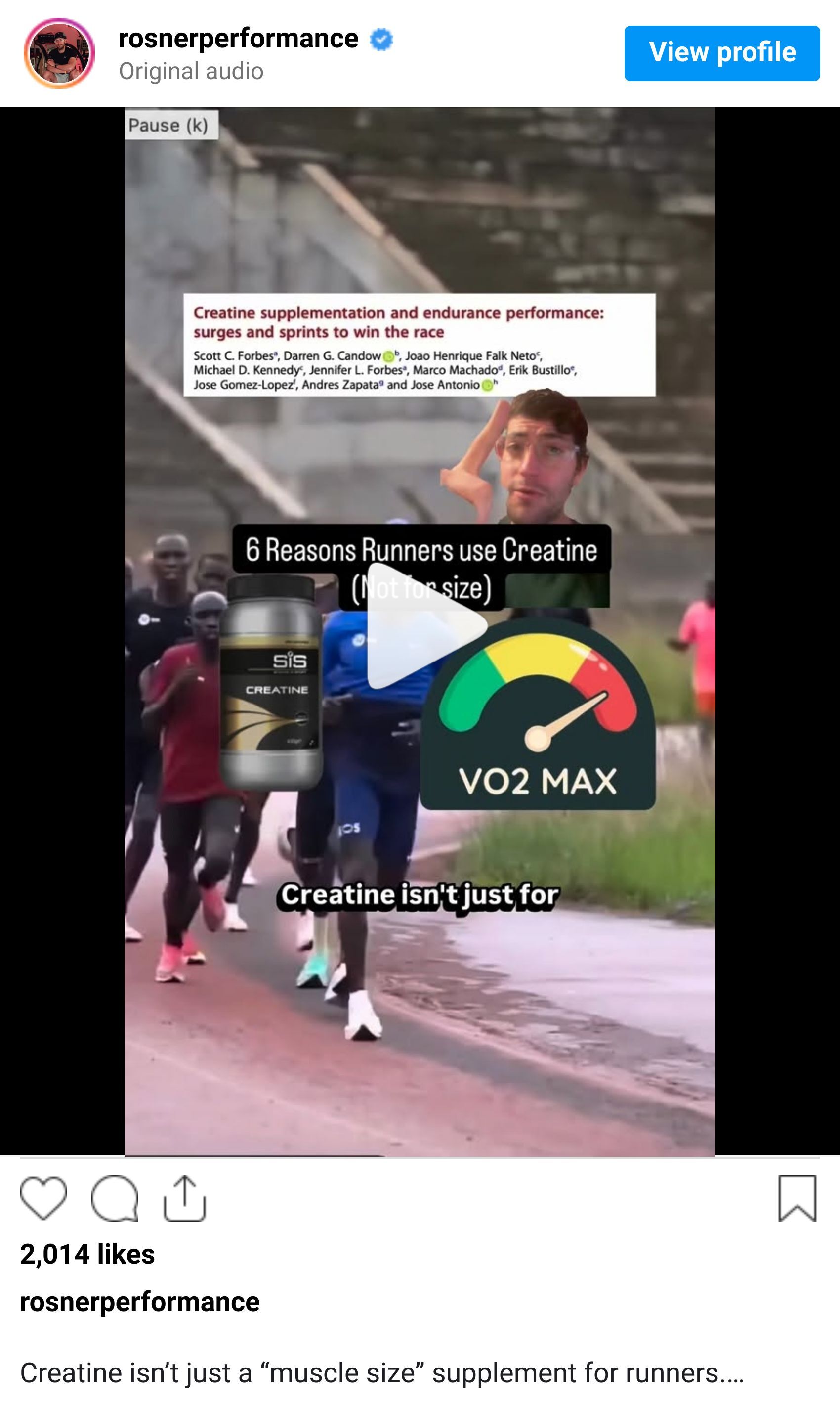
Quick heads up in case you missed it, I shared an Instagram post walking through 6 evidence-based reasons runners may benefit from creatine.
It’s linked below.
If you find it useful, passing it along really helps. These videos take a bit of time to make, and I appreciate the support.
Keep Petting Dogs - Jonah
