

5 Ways Runners Should Be Using BFR (But Aren't) - Part II
Estimated read time: 4.8 minutes (about as long as it takes to title your Strava activity something clever🤔)
Hey Performance Nerds! Jonah here. 🤓
BFR builds muscle at 20% load (We went over this in Part I).
But does it make you faster?
A 2025 split-leg study might have given us an answer: the BFR leg lasted 234% longer before exhaustion. Same athlete. Same training. One leg wore cuffs.
Here's what you'll learn today:
Why BFR might improve endurance (hint: it's not mitochondria)
The 5 ways I actually use BFR in my training
Exact protocols with pressure, sets, reps, and frequency
(Augie watched me do BFR calf raises once. Left the room. Some things are too nerdy even for a dog.)
🎂 I Turned 30 Last Week
No big plans. Ran, lifted, spent time with family and the dogs. Just did what I do every day. And I think that's the point.
I spent my 20s convinced happiness was behind the next achievement. The next job. The next PR. I said no to friends and family because I thought I was building something.
At 30, the biggest thing I've learned: it's okay to just be content.
Distance running taught me that. Some days suck. Some days you love every mile. But eventually you stop, look back, and realize how far you've come.
Trusting the long run. That's how I want to live the next 30.
If you're figuring out the same thing, I'd love to hear about it.

30 today. Still learning that rest days are not a moral failure.
🧬 Performance Sponsors:
🧪 Science in Sport
I use Science in Sport because their products are built from published research, tested with elite athletes, and actually hold up in hard training blocks.
Same fuel I use. No guesswork. No influencer fluff.

🔬 The Endurance Evidence: Why BFR Might Make You Faster
The VO2max Question
BFR training improves VO2max by ~5.7% in reviews. Less dramatic than HIIT, but achieved at walking pace.
The mechanism surprised researchers.
It's Vascular, Not Mitochondrial
The 2025 Journal of Physiology study (Lavigne et al.) used a split-leg design. Same athlete, one leg BFR, one leg control.
Results:
BFR leg: 17% higher peak power output
Capillary density increased 14%
Time-to-exhaustion jumped 234%

The surprise? Mitochondrial capacity improved equally in both legs.
The BFR advantage came entirely from vascular adaptations.
Translation: BFR doesn't build a bigger engine. It builds better fuel lines.
The Capillary Effect
BFR triggers new blood vessel growth through three signals:
Restrict (hypoxia): Low oxygen tells your body to build more blood vessels
Release (reperfusion): The rush of blood flow when you remove the band amplifies the signal
Result: A key growth protein called VEGF spikes 5-7x after each session, telling your body to sprout new capillaries
More capillaries = faster oxygen delivery = better running economy.

For runners who can't add more mechanical load, this is a way to build metabolic fitness without more miles.
🏃 How I Actually Use BFR: 5 Training Applications
1. Injury Rehabilitation (Highest Evidence)
The problem: Stress fractures or Achilles issues mean muscle loss.
How BFR helps: Maintains or builds muscle at 20-30% 1RM. No impact, no heavy loading.
My protocol:
Any lower body exercise (squats, leg press, calf raises): 30-15-15-15 reps
40-60% AOP (arterial occlusion pressure)
30-45 sec rest between sets
3x/week
Evidence: Case studies show ~5-10% quad growth in 4-6 weeks. Tibial bone stress patients preserved bone mineral density.
2. Strength and Hypertrophy (During High-Volume Phases)
The problem: Heavy lifting during peak mileage might hurt quality sessions.
How BFR helps: Build strength and hypertrophy adaptations at 30% 1RM. Minimal systemic fatigue.
My protocol:
Squats, single-leg work, calf raises, or any lower body exercise: 30-15-15-15 reps
60-80% AOP
2x/week (separate from hard run days)
Evidence: Strength improves ~10-15% with minimal systemic fatigue.
3. Aerobic Boost (VO2max and Capillary Density)
The problem: You want aerobic gains without more hard running.
How BFR helps: BFR exercises or cycling trigger vascular adaptations at low intensity.
My protocol:
BFR cycling or single-joint exercises to failure (like the leg extension above)
Intervals: 2 min on / 1 min off x 8 (cycling)
50% AOP (less pressure than strength work — we want sustained effort, not max metabolic stress)
2-3x/week
Evidence: ~5.7% VO2max improvement. The Lavigne study showed 234% longer time-to-exhaustion from vascular adaptations.
4. Recovery and Deloads
The problem: Post-long run soreness and slow recovery between sessions.
How BFR helps: Passive BFR (occlusion without exercise) may speed recovery and deliver fresh blood and nutrients to tired muscles.
My protocol:
Passive occlusion: 5 min on / 2 min off x 3 cycles (Post-Run)
OR light cycling with cuffs for 10-15 min
40-50% AOP (lower pressure — we're not training, just stimulating blood flow)
Post-long run or on easy days
Evidence is emerging. Passive BFR may improve recovery. Not many studies yet, but the mechanism makes sense.
5. Taper and Maintenance
The problem: Losing strength and power during race taper.
How BFR helps: Preserves muscle without the fatigue cost of heavy lifting.
My protocol:
Squats or calf raises: 30-15-15-15
60-80% AOP
2x/week during taper
Keep sessions under 20 min
Evidence: ~6-8% muscular endurance preservation. Growth signals maintain vascular adaptations.
🔧 The Practical Protocol: Quick Reference
Pressure Guidelines (AOP = Arterial Occlusion Pressure)

How to find your AOP: Most research uses automated cuffs. Manual cuffs: aim for 7/10 tightness.
Uncomfortable but not painful. Your leg should not go numb.
Important: Pressures below ~67% AOP may not create meaningful restriction. When in doubt, go higher.
Universal Protocol Framework

Equipment
I use Hytro cuffs (pneumatic, auto-calibrated AOP). I recommend them because pressure is consistent and measurable.
🎯 Practical Takeaways
BFR might improve endurance through vascular adaptations (one study).
The 234% time-to-exhaustion gain came from better blood flow.
5 use cases for runners. Rehab, strength building, aerobic boost, recovery, taper maintenance.
Pressure matters. 40-80% AOP depending on goal. Too loose = no stimulus. Too tight = safety risk.
30-15-15-15 is the gold standard rep scheme. Works for most applications.
2-3x/week is enough. More isn't better. Recovery still matters.
Never exceed 20 minutes of continuous occlusion. Safety first.
Bottom line: BFR isn't just for building muscle. It's a tool for faster oxygen delivery, quicker recovery, and maintaining fitness when you can't train hard.
Are You a True Running Nerd? Prove it.. 🧐
Welcome to the prove you’re a nerd section. Each week, I ask a question about a common running science myth.
Answer correctly, and you’ll be entered into a weekly raffle to win a package of Jonah’s favorite supplements.
After a big jump in training load (volume, speed or both), when does bone stress injury risk often spike, and why?
- A. Same week, impact rises and bone fails immediately ⚡️
- B. 7–10 days later, soreness changes mechanics and overloads one spot 🦵
- C. 3–8 weeks later, bone remodeling creates a temporary “weaker window” while old bone is resorbed before new bone fully forms 🧱⏳
- D. 10–12 weeks later, fitness improves so you run faster without noticing 🏃♂️📈
Last Week’s Results: Oxygen Is the Real Currency 🫁💰
This one was a sneaky reminder that in distance racing, oxygen is the real budget, and carbs spend it best.
The correct answer?
A. They produce more ATP per liter of oxygen than fat, letting you run faster for the same oxygen cost 🫁⚙️ ✅
Carbs are the high-octane fuel because they give you more usable energy per unit of oxygen. When running economy matters, especially at marathon to half-marathon intensities, that better oxygen efficiency means you can sustain a higher pace before you hit the ceiling set by VO2 and ventilation. Fat is amazing for quantity, but it is more oxygen-expensive, so it pushes you toward slower speeds at the same effort.
Here’s how the votes shook out:
🟩 A. They produce more ATP per liter of oxygen than fat, letting you run faster for the same oxygen cost 🫁⚙️ – 205 ✅
⬜️ B. They burn hotter, raising muscle temperature and improving elasticity at marathon pace 🔥🦵 – 9
⬜️ C. They spare electrolytes and reduce sodium losses at steady-state intensities 🧂💧 – 5
🟨 D. They reduce lactate production entirely, keeping muscles in a purely aerobic state 🚫🧪 – 12
Bottom line?
If you want to run fast for a long time, you’re not just fueling muscles, you’re budgeting oxygen, and carbs are the most oxygen-efficient way to buy speed..
Before You Fear Carbs
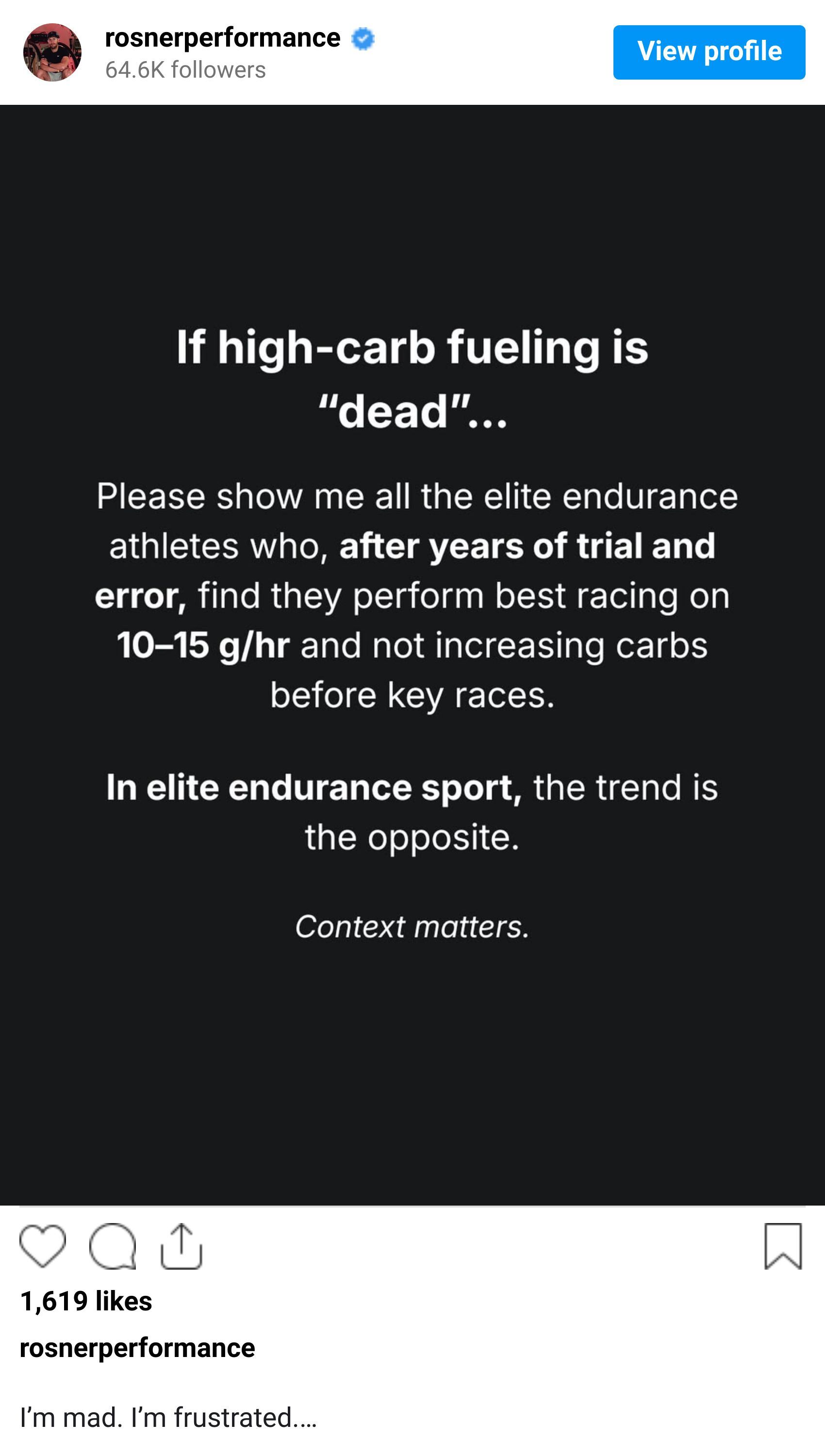
Not sure if you saw my post on Instagram, but the internet is speed-running to conclusions from one review paper.
I’m building a mini-series with PhD experts to separate headlines from physiology, and give you a practical take you can use.